Law enforcement, mental health leaders attend juvenile justice workshop
The Texas Judicial Commission on Mental Health (TJMH) hosted a Juvenile SIM (Sequential Intercept Model). Wednesday, mental health leaders, educators, members of the judicial system, and community stakeholders filled a ballroom at the Mission Event Center to discuss solutions for juvenile justice.
“That’s what our purpose is: that we dive into this workshop and we…not only identify the resources, the services that are already in place but also identifying the gaps and hopefully coming up with solutions,” said Hon. Renee Rodriguez-Betancourt, 449th State Judicial District Court Judge, who is a member of the TJMH.
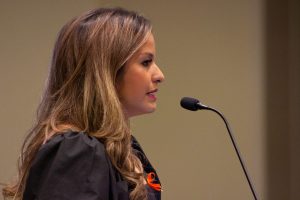
Photo Courtesy of The Texas Judicial Commission on Mental Health.
The workshop aimed for four community goals:
- facilitate mutual understanding and collaboration between community stakeholders
- identify practices, resources, and gaps
- prioritize steps toward system transformation
- create a longer strategic action plan
“It’s a collaboration of so many different stakeholders in our community that maybe know or don’t know that they directly or indirectly affect the youth of our county,” Betancourt said. “There is plenty of work to do. They [the stakeholders] each have a position, service, or some unique contribution to making the system better.”

Attendees networked on the ballroom floor, sharing experiences with juvenile justice. Peñitas Police Officer Jose Cano and Edinburg Consolidated School District Sergeant Maria Sepulveda talked about working with the youth in their cities.
“We deal with the students,” said Sepulveda.
“A lot of them usually start with a lie, and then once you get to know them, once you start talking to them, they eventually open up,” Cano said, stating that recent offenses they’ve seen are substance-related. “Right now, a lot of the effects on juveniles are THC pens, know, a lot of these pills that are going around that affect their thinking, their actions.”
Cano stated that law enforcement, counselors, and judicial members must separate the youth from the substance abuse.

“We need to understand that a lot of times, it’s not them. It’s the narcotics,” he said.
The workshop then highlighted impactful and feasible ideas to handle juvenile justice.
Statewide Leadership Clinic representative Mark Vasquez hopes for reforms in the police and community and works to represent the formerly incarcerated.
“When they have discussions like this…in the law enforcement community, we need to have the voice for the formerly incarcerated, the system’s impact,” Vasquez said.
Interception brainstorming had people listing regional local resources such as the Boys & Girls Club of McAllen and Pharr, the WorkForce Solutions Second Chance Program, Mothers Against Drunk Driving, and Behavioral Health Solutions.

Photo Courtesy of The Texas Judicial Commission on Mental Health.
Split into four groups, attendees discussed solutions for behavioral health, for students to return to school from detention or RTC (responsible thinking classroom), training and coordination for SROs (school resource officers), and family outreach, support, and navigation.
Toribio “Terry” Palacios emphasized focusing on mental health services to prevent children from entering the justice system.
“We see kids that have mental health issues. So, we could catch it early,” he said. “I think it’s a proactive approach to try to educate our teachers, our law enforcement, [and] our mental health providers to try to stop this before it gets out of hand.”
He also hopes to help break the stigma surrounding mental health and seeking mental health services in the Valley.
“A lot of people don’t understand because of our culture,” he said. “That shouldn’t happen.”