
Mission talks drought, water conservation
Mission and McAllen have been at stage two water conservation since August 2022. But with the reservoir levels slowly depleting and rainfall becoming fewer and farther in between, Hidalgo County has to prepare for possible worsening conditions.
A drought has a domino effect on an area — water supply shortages can lead to an increased risk of wildfires and affect the drinking water quality, posing health and safety risks. The agricultural industry takes a hit, which, in turn, affects the local economy. Reduced crops lead to financial losses, higher consumer prices and industry job loss. Prolonged drought can strain a city’s water infrastructure, which can cause local authorities to impose water restrictions on residents.

However, Mission and the surrounding municipalities have a plan to manage limited water supplies.
The Texas Commission on Environmental Quality (TCEQ) requires Mission and other certain entities to develop and implement a five-year Drought Contingency Plan. Although Mission is still working within the plan they created in 2019, the city has to submit an updated version to TCEQ this month. On Aug. 12, city leaders gathered to discuss the new water conservation procedure.
“If you remember last year, we were hit with a very long, hot summer to the point that, for the first time, I saw the term ‘flash drought’ used by the National Weather Service. And the reservoir levels continued to drop through the summer of last year,” Assistant City Manager David Flores said.

According to the National Integrated Drought Information System, a flash drought is the rapid onset of drought, set in motion by lower-than-normal precipitation rates, high temperatures, winds and radiation.
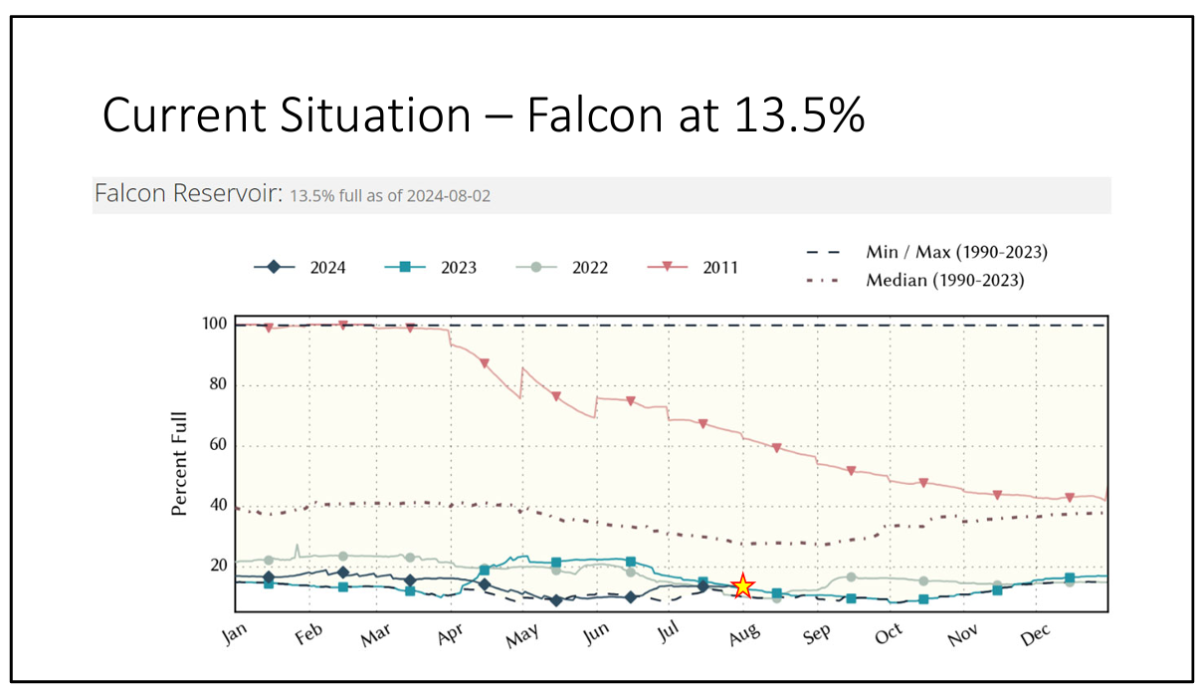
The record heat wave in the summer of 2023 impacted crops and livestock in Hidalgo County. Additionally, the water levels at Falcon Reservoir steadily fell from 24.4% to 20.4% in June alone. City leaders became increasingly concerned about wildfires and water shortages, strongly urging conservation through water use and irrigation practices.
In February of this year, Mission and Hidalgo County Emergency Management hosted a countywide discussion to coordinate efforts with other cities and water provider entities to address the water deficiency issue.

“The intent of the plan is to bring all of us together so that way we can come up with some decision points so we’re all moving in the same direction at the same time,” Flores said. “However, not every entity runs the exact same way. So we looked at just two triggers that we could agree on countywide. And everything else was going to be left up to the individual entity such as demand triggers, reduction goals and surcharges.”
The various city leaders determined which water levels of the Amistad and Falcon Reservoirs would be the trigger points for each of the six stages of water conservation. As of Aug. 12, the Amistad and Falcon reservoirs are at a combined 38.3% capacity. Every time the reservoirs fall below a specific capacity for 30 consecutive days, the municipalities enter a new water conservation stage.
The combined reservoir capacity trigger points are as follows:
- Below 40% – triggers stage two
- Below 30% – triggers stage three
- Below 20% – triggers stage four
- Below 15% – triggers stage five
- Stage six – determined by the city manager
Water plant capacity also helps determine Mission’s water conservation stages. Mission residents get their water from two water treatment plants, but the raw water source is from the Rio Grande River, which comes from the reservoirs via irrigation canals. The two water treatment facilities treat a combined 25.5 million gallons per day. When water demand reaches or exceeds a specific delivery capacity, the city may enact a higher water restriction stage.
Since entering stage two water conservation in 2022, Mission city leaders have already set a few water restrictions — prohibiting the washing of sidewalks and driveways, fire hydrant testing and limiting other forms of water use throughout the city. But every time the city enters a new stage of water conservation, the regulations become more stringent, such as prohibiting vehicle washing, watering golf and park facilities and irrigating landscaped areas, to name a few.
However, Mayor Norie Gonzalez Garza was adamant that she did not want the city to stop construction on projects at any point, despite the assistant city manager’s proposal to implement the prohibition at stage four water conservation.
“I would rather that not be at any stage,” she said. “I would rather restrict the water use of the car wash than a construction company.”
Councilmember Ruben Plata agreed.
“I would rather put no restrictions. God forbid if it gets to that point, we can always call up a special meeting,” he said. “If we adopt it right now, and we approve it, I think it’s going to give us a lot of [issues]. People are going to feel like we’re stopping the growth. Even if it is [not] until stage six, I think it would make us look bad.”
Flores agreed to remove the item from the 2024 Drought Contingency Plan, along with a surcharge for water usage, at the mayor’s request. The assistant city manager said the county agreed to implement surcharges for water usage at stage three conservation. But Gonzalez Garza wanted to hold off on implementing the increased rate for now. Although 60% of Mission’s residents likely would not be affected by the proposed conservation rates, the mayor would like to add the discussion to the agenda at a later meeting.
Whatever decisions Mission city leaders make, the idea is for the whole county to reach a consensus.
“We’re going to take this discussion back to the county to see what the other cities are thinking of,” Flores said. “And the thought is that if we’re all thinking the same thing, we all pull the trigger at the same time, then we’re united. That was the reason they brought us together back in February — ‘Let’s all do this together.’”




When I see all the evidence, everyday of the City of Mission approving building permits for new homes and commercial buildings it makes me question their reasoning for it, if the shortages truly exist.
If the water is truly in such short supply, why build more homes? More homes equals more water usage, which means tighter water restrictions for everyone. Does this make any sense to anyone?