Texas Redraws Congressional Lines, RGV May Squeak By
The Texas Legislature will hold hearings over the next few days to receive feedback from the public on proposed new congressional district lines, and State Senator Juan “Chuy” Hinojosa (D-McAllen) said he has not yet seen a map for consideration.
“We don’t have a map,” Hinojosa told the Progress Times on Tuesday. “I’m sure there’s one being drawn by the (President Donald) Trump administration as far as what they want, but I haven’t seen anything.”

Proposed map filed with the state’s redistricting website identified as PlanC2201, and if successful, could squeeze another congressional district into the Rio Grande Valley, and possibly dilute voting power of Hidalgo and Cameron counties.
Hinojosa was appointed to the Senate Special Committee on Congressional Redistricting earlier this week by Lt. Gov. Dan Patrick.
Congressional redistricting is a method of redrawing the lines of districts in which US Representatives are elected to Congress, and making a map available to the public for comment is essential to the process. Normally, redistricting occurs every 10 years, after a US Census, to ensure the electoral districts contain roughly the same number of people and to mirror any population changes. Texas completed redistricting in 2021.
The outcome of redistricting can affect the party’s ability to aid its candidate in election, by cherry picking the voters within those lines to secure a win. Each US representative plays a role in the amount of federal funding the region might receive for its projects, thus affecting the quality of life for residents inside those lines.
“Traditionally, redistricting is done after the census, every 10 years,” Hinojosa said. “Mid-term redistricting is done for pure political reasons. There’s been a push for regional public hearings in-person around the state, but right now that is not in the plans.”
The Senate Redistricting Committee will accept public comments during several virtual meetings. The public can submit comments at https://senate.texas.gov/redistrictingcomment/
The House Select Committee on Congressional Redistricting will hold hearings in Austin, Houston and Arlington over the next few days. Feedback can be provided at https://comments.house.texas.gov/home
“We (the Senate committee) start on Friday morning at 10 am here in Austin,” Hinojosa said. “And then we have another hearing on Saturday at 10 am, Monday at 3 pm, and Tuesday at 9 am, and all of them are by Zoom. Anyone can testify.”
More information and links to the online hearings can be found at https://redistricting.capitol.texas.gov

As of press time, no maps or bills have been sent to either committee. The state’s redistricting portal shows at least 42 proposed maps have been submitted by the public for consideration, but none bear the name of Senator Phil King (R-Weatherford) or State Representative Cody Vasut (R-Angleton), who serve as chairmen for the redistricting committees.
The US Department of Justice (DOJ) recently sent a letter to Texas Governor Gregg Abbott questioning the legality of four current congressional districts, none of which are located within the Rio Grande Valley: three are located in Houston and one in the Dallas-Ft Worth area. Three are now represented by minorities and the fourth is vacant and was most recently held by a minority.
“Right now, they’re pinpointing those four districts,” Hinojosa said. “And right now, we don’t know if the Valley will come under scrutiny, not even my Republican colleagues know that.
“But I do know that the margin between the Democratic candidate Michelle Vallejo and Republican Congresswoman Monica De La Cruz was small, so it’s very difficult to be able to change much in that district without putting De La Cruz in jeopardy.”
De La Cruz (TX-15), whose district is anchored in McAllen, won re-election with 57 percent of the vote in November 2024.
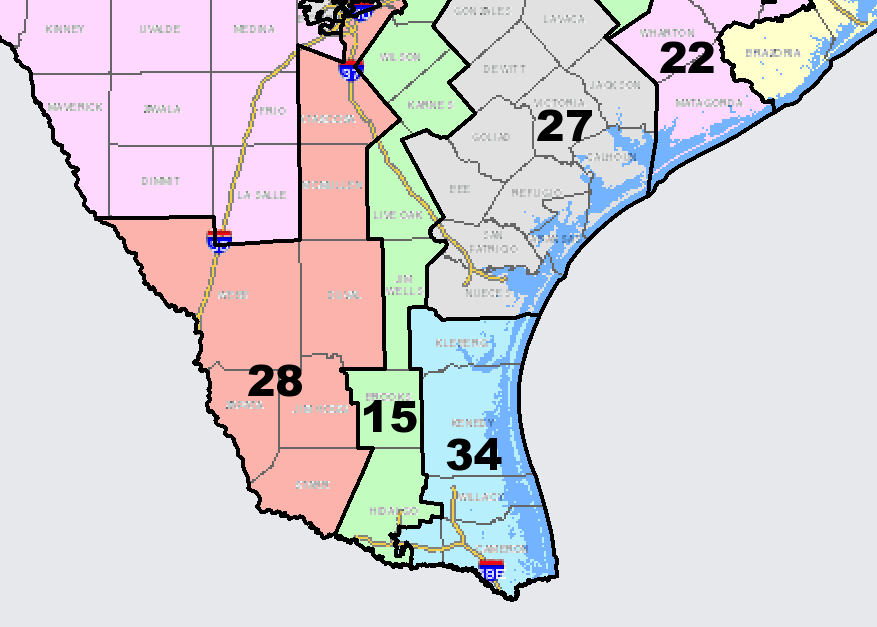
Shows the current Congressional Districts that contain the Rio Grande Valley: District 28 (US Rep.Henry Cuellar), District 15 (US Rep. Monica De La Cruz), and District 34 (US Rep. Vicente Gonzalez).
De La Cruz’s district director Ruben Villarreal referred the Progress Times on Wednesday morning to communications director Brigid Nealon for comment on redistricting. As of press time on Thursday, Nealon had not responded to an email seeking comment on potential movement of De La Cruz’s district lines.
The DOJ’s letter to Abbott, dated July 7, required a response from Texas on the same day, advising of its intent to bring its current redistricting plans into compliance or risk legal action by the US Attorney General, and claimed the four congressional districts were “coalition districts,” mainly comprised of minorities who could vote together to elect a minority candidate.
In 2021, Republican lawmakers stated that racial data was not considered when those districts were formed, according to archived public hearing recordings.
A State Senator for over two decades, Hinojosa is no stranger to the redistricting process in Texas, and he is often appointed to the committee overseeing the map changes in that chamber. He served as the committee’s vice-chairman in 2021.
Hinojosa was among the 11 Democratic senators who left Texas and went to New Mexico in 2003, to deny the Senate chamber a quorum and prevent a vote on the proposed redistricting map pending at that time. Hinojosa secured the private jet used to transport the senators to Albuquerque for a stand-off that lasted about 30 days, to force negotiations between the political parties.
“Doing redistricting now, the state is taking a risk that could result in a blue wave,” Hinojosa said, referring to the color blue which is associated with the Democratic party. “Independents who might not be happy with Trump’s redistricting effort could instead vote Democratic, and that would build a check on Trump’s power in Texas.”