City’s credit rating tumbles as latest audit is released
The Mission city council accepted its late annual audit on June 26, nine months after its due date, and learned that it remains in violation of its own ordinance which requires the city to maintain two months’ worth of operating expenses in reserve.
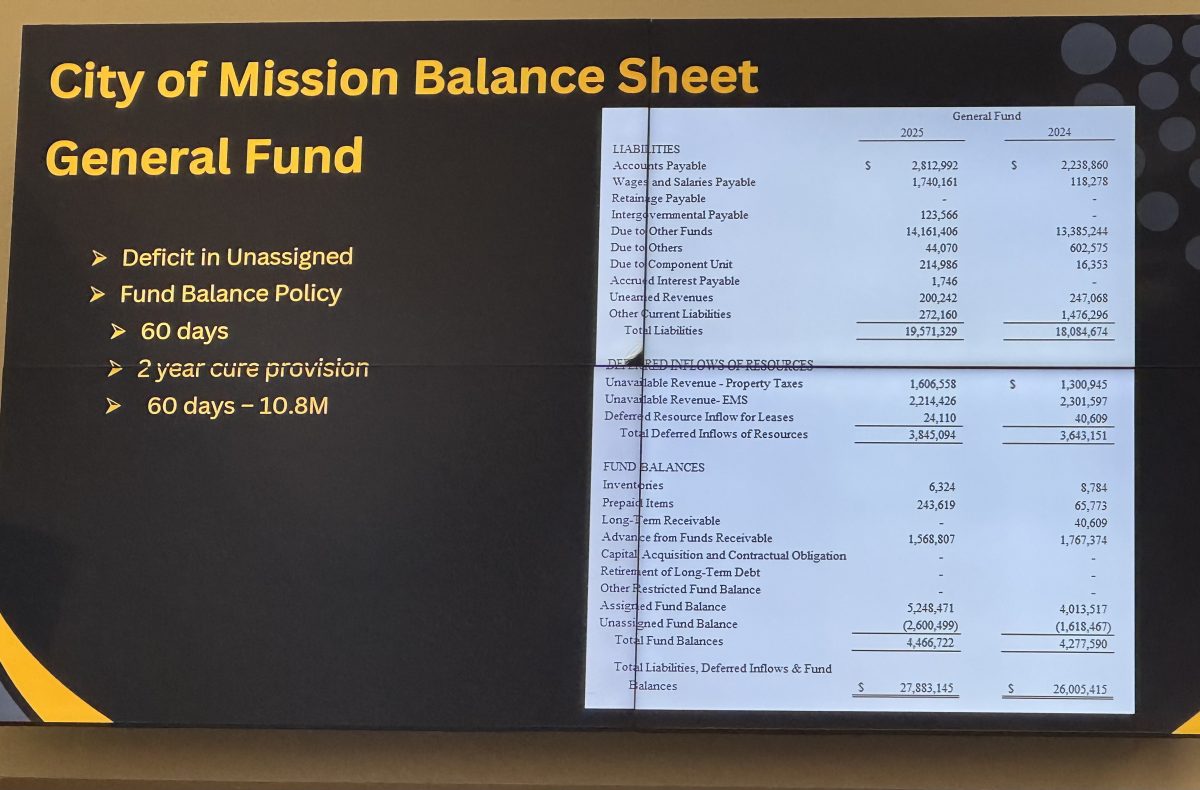
While Mission ended the year with a net worth of $240,817,305, the council overspent in its main account by $982,032, and it is now $2.6 million in the hole in its general fund. For its 60-day emergency account, the city is required to have $10.8 million saved.
The money woes come as S&P Global Ratings downgraded Mission’s credit rating from A-minus to BBB+ on June 25, which can make it more expensive to borrow money, as investors might consider the city a financial gamble. The credit rating tumble usually results in a higher interest rate when cities borrow money. S&P is a worldwide independent credit rating agency.
The Mission EDC’s credit rating also dropped from A to A-minus on the same day.
CPA Ricky Longoria unveiled the audit report to Mayor Norie Gonzalez Garza, Councilman Beto Vela and Councilwoman Marissa Gerlach. City secretary Anna Carrillo stated that Councilwoman Jessica Ortega was absent, and Councilman Ruben Plata joined via Zoom, even though no Zoom link or livestream was made available for public use.
Unlike the 2024 audit, the latest audit for the end of fiscal year 2025 was not made available as part of an agenda packet or at the meeting for the public to view. A few select pages of the 253-page audit were displayed in the council’s chambers, and at least one slide shown was blank.
Longoria last addressed the council in March 2026 when he presented the fiscal year 2024 audit, which the city completed about 18 months after the deadline.
“Your unassigned balance is still unfortunately a deficit, last year we discussed the deficit of $1.6 million and that has grown now to $2.6 million dollars,” Longoria said.
“What I will say is this: last year, we talked a lot about the city’s own policy with respect to fund balance and its own policy does not just consider the unassigned fund balance,” Longoria said. “It considers the sum of the assigned fund balance and unassigned fund balance.”
“From that perspective its positive, if that’s the way the city wants to look at it, but I just don’t think you can ignore the fact that in that computation, part of that is still negative,” Longoria said.
Longoria also pointed out that while the city of Mission is required to have 60-days’ worth of operating expenses saved, the city only had about 14-days stashed away in both 2024 and 2025.

“Once you have a negative fund balance then you have two years to make that whole and it’s still below the 60-day threshold,” Longoria said.
“There really hasn’t been, just by the results, there hasn’t been an effort to try and meet that policy,” Longoria added. “At some point, someone has to stand up and say, ‘We have to be true to the policy,’ otherwise, why have a policy? It just doesn’t make sense.”
Looming large within the audit is Mission’s EMS, which was listed with unavailable revenue of $2.2 million dollars.
Unavailable revenue means the EMS department successfully performed and billed for $2.2 million in emergency medical services, but those invoices have not been paid.
The council did not ask Longoria any questions at the end of his presentation.
Co-interim City Manager Andy Garcia said he is currently working on a draft budget for the next fiscal year which begins on October 1. By law, the council must approve the budget no later than September 29. Garcia is required to make his proposed budget available for public review at least 30 days before the city council sets its tax rate for next year and accommodate a public hearing prior to that council action.
The city council can’t impose a property tax increase because the audit was completed and filed about 9 months after the due date with the state of Texas, in accordance with a new state law.
Last year’s budget process was more transparent under former city manager Mike Perez, as several workshops were held and open to the public, so residents could hear the funding requests of various departments. So far this year, no budget workshops for the public have been scheduled.
While the audit is finalized and filed with the state, Longoria’s work is ongoing.
“We are still working with 140 audit adjustments,” Longoria said. “Those still need to be worked on if the challenge is to be met in respect to the 2026 audit.”
The 2026 audit deadline is in March of 2027.