TEA Commissioner lauds La Joya ISD progress at intervention anniversary
In the middle of an interview last year, just after the Texas Education Agency finally decided to replace La Joya ISD’s leadership, Commissioner Mike Morath took a moment to stop chatting about the district’s troubled past and its prospective new future to speculate on what could have been.
After significant resistance, the TEA had decided to use the strongest level of intervention in its possession to appoint a board of managers to run La Joya ISD after years of corruption.
Plenty of action followed that decision.
The state promptly shelved the district’s elected board.
A newly appointed board came in with a new superintendent. The regime made changes quickly.
People in the community worried, often over jobs or politics.
Morath’s mind, on the cusp of that organized tumult, strayed toward the district’s classrooms and he wondered about what a district that already performed well academically would be achieving if its past leaders hadn’t “effectively stolen” large amounts of money from the community’s children.
He wondered what programs that money would have funded, what counselors it would have paid for.
Even what books it might have bought.

“We hope to see a district that’s more responsive to meeting the needs of students, and that embraces the kind of things that need to be true for kids,” Morath said at the time. “We want kids to be in rigorous learning environments, engaging with rigorous and broad based lesson materials that teach them to be educated citizens. Those kinds of improvements folks should see slowly but surely under the board of managers.”
On Monday, precisely one year and two days after Morath installed a board of managers for La Joya ISD, he flew down to the Rio Grande Valley to see whether he had been right or wrong.
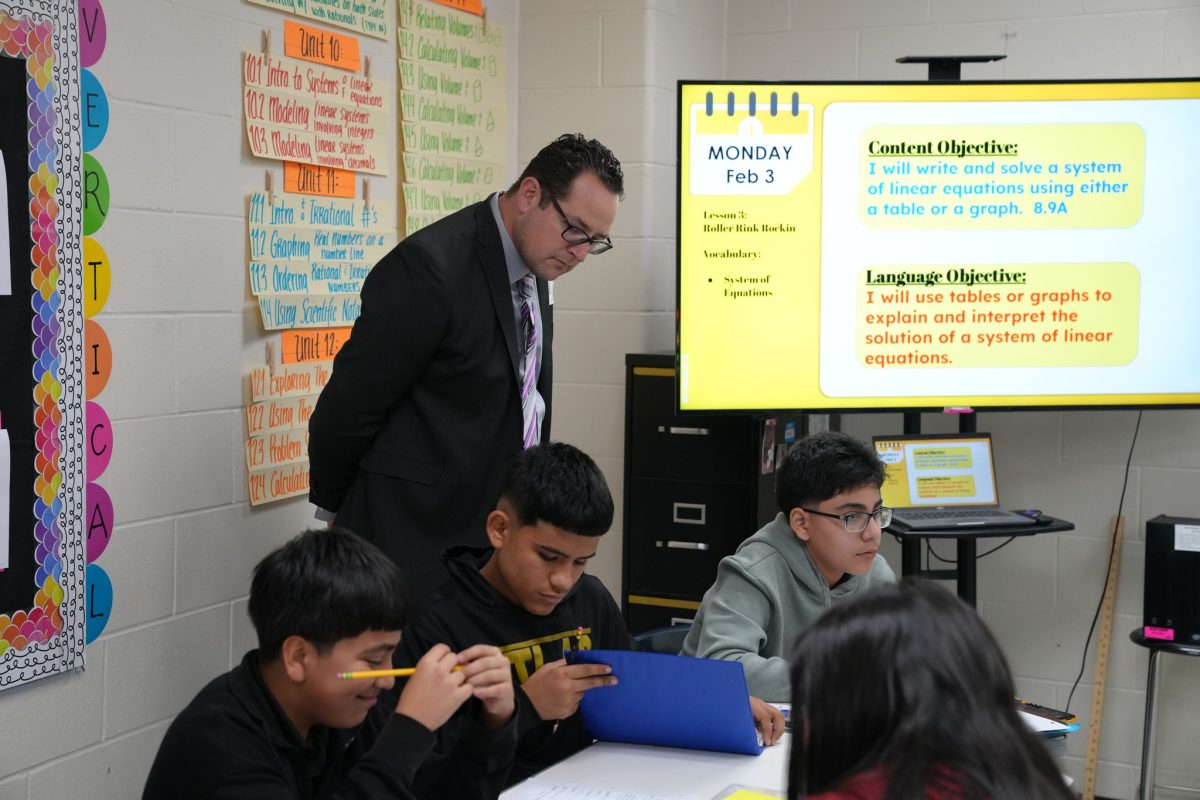
A tour of about 10 classrooms in two schools — Enrique Camarena Elementary and J.D. Salinas Middle School — convinced the commissioner that he’d been right.
“I saw amazing instruction,” he said. “They’ve done some really substantive curricular upgrades in this year. The term that we use, it’s bandied about in education circles: rigor. It’s really just [whether we’re] giving kids opportunities to learn hard things.”
Morath, during his tour, tended to ask teachers whose classrooms he visited sometimes pointed questions, paying attention to what was going on in their lessons.
The district says it’s rolled out a variety of curriculum initiatives this year popular with the state: Eureka Math and Carnegie Math, new Pre-K curriculum that aligns with state materials, supplemental materials through Lexia, which provides literacy programs.
“What I saw today was a substantive upgrade in terms of the quality of rigor that kids are getting,” Morath said. “And the teachers were just on fire, it was amazing to see.”
Board President Julian Alvarez, who toured campuses with Morath, said he saw the commissioner’s visit and his support of the district’s curriculum changes as a show of support for efforts district leadership has taken in the past year.
“So that means a lot,” Alvarez said. “Because there’s a lot of folks who unfortunately pay too much attention to what’s being said on social media — and it’s not always positive — but his reassurance is that what we’re doing is what other districts in the state are gonna follow.”
That criticism has, not infrequently, gone beyond social media.

The new board of managers has made some difficult decisions in the past year.
At times they’ve made controversial decisions.
Early in its tenure, the board approved a novel policy that bars supervisors at the district from holding elected political office — a policy Morath described Monday as “wise” and potentially worth replicating elsewhere.
That policy led to at least one termination and several resignations from the district or elected bodies in the area.
Though it impacted a relatively small number of employees, those employees were leaders in their communities, some of them public supporters of intervention.
Other measures affected more people.
Facing a massive $55.3 million deficit, the district dismissed 175 employees last year and made a variety of belt-tightening measures.
Morath, who noted that school systems nationwide are struggling to adjust to the end of an influx of federal monies, said he’s pleased with the new board’s financial decisions.
“La Joya previously has had some challenges in those areas, and you’re seeing all of that get made much more efficient for the taxpayers very quickly,” he said.
Those were early hurdles for the new leadership. Now it’s facing new hurdles.
Last semester the district embarked on campus consolidation measures that were frequently opposed by students and community members.
That issue attracted the attention of State Board of Education Member LJ Francis, who last week was critical of the district’s plans.

On Monday, however, Francis accompanied Morath on his tour. Though he still had reservations about how the district communicated consolidation plans, he didn’t describe himself as an opponent of intervention efforts.
“I think one thing that distinguishes the Valley is that we know when things are wrong,” he said. “I believe that the district, the parents and the community have supported this intervention because student outcomes was not what it should be. And so I’ve seen where the community has more confidence in the school district in terms of the initial turnaround and just more focus on student outcomes.”
Francis is perhaps the first politician to flirt with public criticism of La Joya ISD’s new leadership.
Criticism has mostly been confined to sporadic public comments at board meetings or petitions that haven’t gained significant traction.
That’s not the case in Houston ISD.
That district got a board of managers in 2023 and has since been a battleground: intervention has found enemies in a member of congress, vocal parent groups, unions and other officials.
La Joya’s intervention hasn’t been so dramatic. Representatives for the two most active teachers’ unions in the district accompanied Morath on his tour. Elected officials in the area have been largely quiet publicly, and criticism from employees and staff has been isolated and not broadly organized.
Even critical members of the district’s elected board, which is powerless but still extant, have declined to use their positions for advocacy.
“I think everybody is pretty much like, ‘They said they were gonna handle it, let them handle it. Let’s see how they’re going to handle it,’” said Esmer Solis, who opposed intervention as La Joya ISD’s board president last year. “Because at this point, what are we going to do?”
Solis says she’s still not a fan of intervention, and though she hopes it succeeds, she worries about it because of what she’s heard from the community.
“I think they’re disappointed,” she said. “I think they’re scared. I think they’ve lost their only means of communication was through the board, and now they feel they don’t have that communication.”

Brenda Solis is the La Joya AFT President. Her union didn’t oppose intervention, and she says she’s found she can work with the new administration.
“Our members’ voices are being heard. Issues, concerns are being addressed,” she said. “In the past, we didn’t have this working relationship,” she said. “It was a constant battle.”
The face of the state’s intervention effort is Marcey Sorensen, the superintendent Morath appointed to helm the district last year.
Sorensen says the board’s relationship with the community is different now, but it’s different because the board is following policies recommended by the state.
That doesn’t mean leadership is inaccessible, she said.
The district’s frequently offered meetings with groups of parents and stakeholders. Sorensen goes to things like ribbon cuttings and community events.
“I know that there are really difficult decisions that have been made, but I’m really present, and so is my cabinet,” she said. “And we’re accessible to answer questions, really honestly and really transparently.”
Mostly, Sorensen says, the new administration has responded to things people in La Joya ISD said were going wrong in the district, particularly retaliation.
“When I first came in, the thing I kept hearing over and over again was a need to stop being afraid of political retaliation. ‘Please make that stop.’ And that’s stopped,” she said. “We needed human resources to be a place where reassignments don’t happen anymore. And that’s not happening anymore. People needed to know clear policy was being implemented, and those things are being implemented.”